
Miller 400D
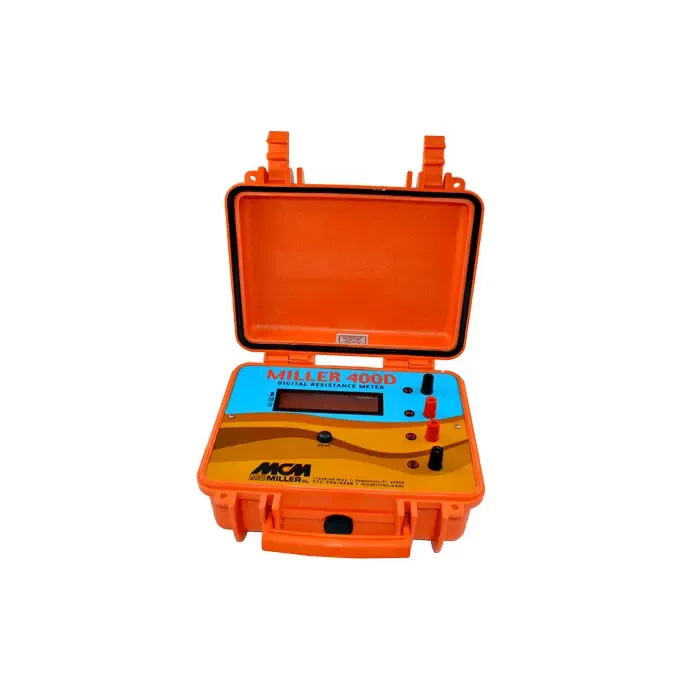
- SKU#: 04-15736
- SoilResistivity testing made easy! Resistance Readings with the Push of a Button. Unique, Error-free Data-logging Option.
Attachments

-
When combined with appropriate electrodes (pins) and test leads, the MILLER-400D can be used to measure earth resistance with the push of a button. There is no need to adjust dials or select ranges; the MILLER-400D automatically provides a directresistance reading.
In addition to taking (and recording) readings manually (see Section 2), a WPAN-enabled computer (PDA, laptop etc.) can be programmed to acquire resistance readings directly from the Miller 400D, since the resistance meter has a built-in WPAN interface (see Section 3). In the latter case, the PDA or PC, which is in control of the WPAN link, commands the Miller 400D to take a reading and the resistance value is sent automatically to the PDA or PC. -
400D Features
- No need to select ranges or adjust dials – the Miller 400D provides a direct read-out of resistance with the push of a button
- WPAN interface allows optional data-logging via a WPAN - enabled PC (or PDA)**
- Rugged, hard plastic case - safe to use on wet ground
- Resistance measurement range from 0.01Ω to 10 MΩ (auto-ranging)
- High resolution digital display
- Resistance measurements are unaffected by any stray interference signals that may be present in the earth during readings, due to the use of narrow band-pass filters centered at 82.2 Hz (the unit's operating frequency)
- Runs on a set of replaceable D-Cell Industrial Alkaline Batteries. No need to periodically recharge the unit or to plug it into a power source.
- Performs 10,000 single readings on a fresh set of batteries.
400D Data-logging Capability:The Miller 400D Resistance Meter is supplied with an "over-the pipe" soil resistivity survey program, known as ProCP Soil Resistivity, based on the 4-Pin Wenner Methodology.
400D Software Features & Benefits- Errors associated with writing down resistance meter readings and subsequently calculating soil resistivity values based on pin spacings are eliminated using the ProCP Soil Resistivity program in conjunction with the Miller 400D Resistance Meter
- M.C.Miller's ProCP Soil Resistivity application can be run on "off-the-shelf" PocketPC hardware (Windows Mobile 5.0 or higher) or on a laptop PC. Hardware must be WPAN - enabled
- Reading locations are represented by user-entered station numbers and readings are automatically position and data/time stamped in cases where a GPS receiver is integrated with the user's handheld unit
- Data can be stored for up to 4 electrode (pin) spacings per reading location. Pin spacing values are user-entered in "feet" or in "meters"
- Resistance data directly acquired from the Miller 400D are converted to soil resistivity values (expressed in ohm.cm units) for each selected pin spacing value. Measured resistance and calculated resistivity values are both stored per reading
- Survey data is stored in XML files for easy reading by other applications, including ProActive, M. C. Miller's Pipeline Integrity Data Management application. ProActive users are able to easily integrate soil resistivity survey data with other "over-the-pipe" survey data for enhanced data analysis. A conversion to XLS file format (Excel Spreadsheet) option is also included
-
- Storage temperature range (with batteries installed): -40°C to 50°C (-40°F to 122°F)
- Operating temperature range: -20°C to 54°C (-4°F to 129°F)
- Weight: 8.6 pounds (3.9 kg)
- Width: 12.0 inches (30.5 cm)
- Length: 10.5 inches (26.7 cm)
- Height: 5.75 inches (14.6 cm)
Accuracy:0.01Ω to 1MΩ range ±1.6% ±1LS Display Digit ±0.01Ω1MΩ to 10MΩ range* ±5% ±1LS Display Digit
* For load resistances greater than 1MΩ, in addition to internal meter errors, errors associated with test lead proximity can also be significant (please see Influence of test lead proximity on the accuracy of AC resistance meter readings). When test leads are in close (physical) contact with each other, mutual capacitance and mutual inductance effects can impact the current and voltage, respectively (and hence the resultant resistance value). In such cases, the load (appearing across the input terminals of the meter) is not purely resistive, but, has reactive components as well. The solution to this issue is to make sure that the test leads are physically separated from each other in cases where the soil resistance is greater than 1MΩ.